Generating signals
The signal (truth= in code) answers the question "what should a method find?": one feature,
any member of a correlated group, or most of a pathway. It states which features generate the
outcome and in what structure. From it PyPlasmode computes the generating score
(truth.signal), one number per row, and the recovery targets a selection is scored against; the
outcome model sets how strongly the score acts on the outcome.
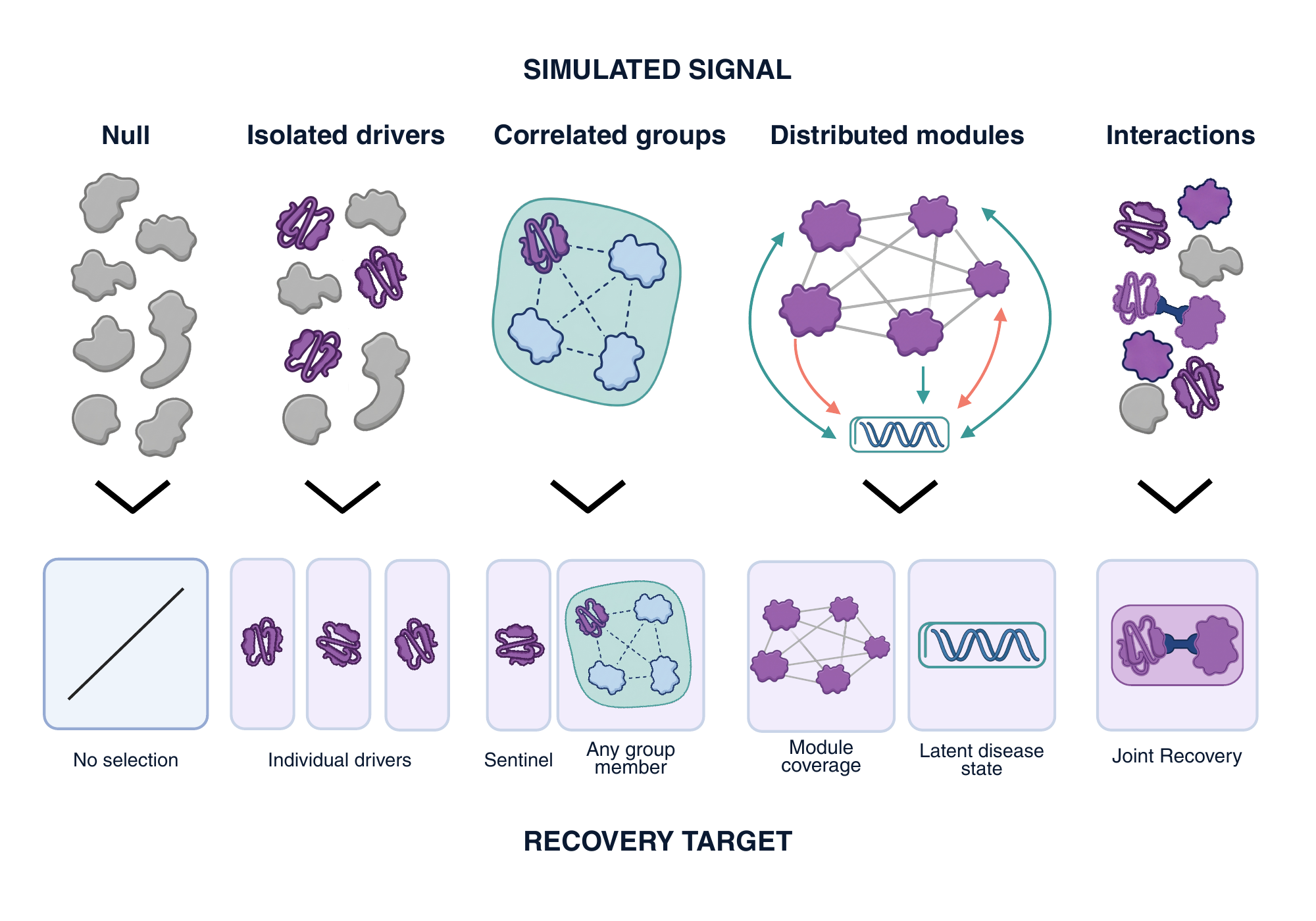
In the diagram, the "drivers" are the generating features, and the "latent disease state" is the generating score. The tutorial compares sparse and correlated signals on the same measurements.
Null
A null signal asks how often a procedure reports features when there is nothing to find.
Write NullTruth(). The generating score is zero on every row, so no feature affects the
outcome, and any feature selected is a false selection. Recovery cannot be computed since there
are no generating features, so count instead how many features are selected and how often the
same features recur across repeated datasets. Recurrence shows which features the procedure
tends to pick when there is nothing to find.
Sparse
A sparse signal tests whether a method finds the few individual generating features themselves when their correlates could also be selected.
Write SparseTruth(features=...) to name the generating features, with optional non-zero
weights (default 1.0 each), or SparseTruth(count=...) to let PyPlasmode choose that many, no
two of which are near-copies (Signal construction). Measure
recovery with evaluate_ranking.
import numpy as np
import pyplasmode as ppm

a = np.array([-1, -1, 1, 1])
b = np.array([-1, 1, -1, 1])
names = ("A", "A_proxy", "B", "C")
population = ppm.Population(np.column_stack((a, a + b / 2, b, a * b)), names)
ranking = ("A_proxy", "A", "B", "C")

sparse = ppm.SparseTruth(features=("A", "B"))
sparse_truth = ppm.materialize_truth(sparse, population, seed=3)
print(ppm.evaluate_ranking(ranking, sparse_truth, depths=(2,)).at_depth[0].recall)
# 0.5

auto_sparse = ppm.SparseTruth(count=2, max_absolute_correlation=0.7)
print(ppm.materialize_truth(auto_sparse, population, seed=3).direct_features)
# ('C', 'B')
The examples on this page share a four-row population: every combination of A and B at −1 and 1, a
correlate A_proxy (A plus half of B, correlation 0.89 with A) and C, the product of A and B.
ranking stands in for a model's importance ranking, most important first. materialize_truth
computes the generating score and recovery targets without simulating outcomes. The top two
features hold A but not B, so recovery is 0.5 (the API calls it recall). The automatic choice
accepted C and B; it could never accept both A and A_proxy, because their correlation of 0.89
exceeds the limit.
Correlated
A correlated signal asks if a method finds a generating feature or settles for one of its correlates, measured features strongly correlated with it.
Put each generating feature and its correlates in a named FeatureSet, pass them as
feature_sets to generate, and write CorrelatedTruth(group_names=...), with one weight per
group (default 1.0). Groups must not share members, so that a selected feature counts towards one
group only. There are two forms:
- One generating feature per group (the default), the group's sentinel (
sentinels=in code, drawn at random from each group if omitted); the other members only correlate with it. This asks whether a method picks the right member. - Group means (
signal_form="group_means"): every member contributes its standardised value to the group's average, so no member is the right one. This asks whether a method finds the group.
correlated_sets = ppm.FeatureSets((ppm.FeatureSet("A_group", ("A", "A_proxy")),))
correlated = ppm.CorrelatedTruth(group_names=("A_group",), sentinels=("A",))
outcome = ppm.ContinuousOutcome(mean=0.0, standard_deviation=1.0, variance_explained=0.25)
correlated_sample = ppm.generate(
    population,
    truth=correlated,
    feature_sets=correlated_sets,
    outcome=outcome,
    sample_size=4,
    sampling_method="without_replacement",
    seed=3,
)
print(ppm.evaluate_groups(ranking, correlated_sample.truth, depths=(1,)).at_depth[0].group_recall)
print(ppm.evaluate_ranking(ranking, correlated_sample.truth, depths=(1,)).at_depth[0].recall)
# 1.0
# 0.0
Only the recovery targets matter here, so the outcome is arbitrary. Measure recovery with
evaluate_groups and, for the sentinel form, evaluate_ranking. A is the sentinel, but the
ranking puts A_proxy first, so at depth 1:
| Evaluator | Group found if the selection holds | Recovery |
|---|---|---|
evaluate_groups |
any member | 1.0 |
evaluate_ranking |
the sentinel itself | 0.0 |
Reporting both shows how often a method finds the right group but the wrong member. The
group-means form has no sentinel. Use evaluate_groups for group recovery or evaluate_module
for the share of generating weight the selection covers.
Distributed
A distributed signal lets you ask how much of a signal a selection captures when many features each carry part of it, as the members of a biological pathway might.
Write ModuleTruth(set_name=...) and pass the named feature set in feature_sets to generate.
The score adds the standardised values of every member, each multiplied by its weight (default
1.0, in set order). Measure recovery with evaluate_module: the absolute weight of the selected
generating features divided by the total absolute weight, so a sign does not reduce credit.
module_sets = ppm.FeatureSets((ppm.FeatureSet("pathway", ("A", "B", "C")),))
module = ppm.ModuleTruth(set_name="pathway", weights=(2.0, -1.0, 1.0))
module_sample = ppm.generate(
    population,
    truth=module,
    feature_sets=module_sets,
    outcome=outcome,
    sample_size=4,
    sampling_method="without_replacement",
    seed=3,
)
coverage = ppm.evaluate_module(ranking, module_sample.truth, depths=(2,))
print(coverage.at_depth[0].weighted_coverage)  # 0.5
The weights give A twice the weight of B or C and make the score fall as B rises. Coverage uses absolute weights, so B's −1 counts as 1. The top two features are A_proxy and A. A carries 2 of the 4 units of weight, so coverage is 0.5.
Coverage gives A_proxy no credit, although it carries much of A's information. To measure how well
the selected features predict the generating score on held-out rows, whichever features they are,
use evaluate_signal_reconstruction. evaluate_ranking
raises ValueError for this signal, because it has no individual generating features to find.
Interaction
Can a method detect features that matter only in combination, as when risk rises only if two measurements are both high? An interaction signal lets you test this. With the product form, each feature on its own can show no association with the outcome. A method that judges features one at a time can therefore miss both.
Write InteractionTruth(features=("A", "B")) and choose the operation:
"product"(the default) multiplies the two standardised values, so the effect of one feature is proportional to the other's value, and reverses when the other is below its mean."threshold"gives 1 when both standardised values are abovethreshold(in standard deviations, default 0.0) and 0 otherwise.
Measure recovery with evaluate_fractional_recovery(..., estimand="interaction"): the probability
that the selection contains both features.
interaction = ppm.InteractionTruth(features=("A", "B"), operation="threshold", threshold=0.0)
interaction_truth = ppm.materialize_truth(interaction, population, seed=3)
selection = ppm.nomination_from_scores(names, (3, 0, 1, 1), depth=2)
interaction_recovery = ppm.evaluate_fractional_recovery(
    selection,
    interaction_truth,
    estimand="interaction",
)
print(interaction_recovery.value)  # 0.5
nomination_from_scores keeps the top two of the importance scores 3, 0, 1 and 1 for A, A_proxy,
B and C (the API calls a selection a nomination). A is selected, and B and C tie for second
place, so each is selected with probability 0.5. Only one of the two ways of breaking the tie
completes the pair, so recovery is 0.5.
A threshold that every row or no row clears on both features makes the score constant.
Generation raises ValueError, because a constant score cannot be standardised. Lower the
threshold if no row clears it. Raise it if every row does.
Custom signal
A custom signal asks a question the built-in structures cannot, such as whether a method copes with a response that flattens at extreme measurements.
Wrap a function in CustomTruth(function=...). PyPlasmode calls it with the sampled matrix
(read-only), its column names and a seeded NumPy random generator, and standardises the signal
of the CustomSignal it returns, one value per row. Recovery is measured against the targets you
declare in it: direct_features for
evaluate_ranking, groups for evaluate_groups, weights for evaluate_module and
graph_region for evaluate_graph_region.
def saturation(X, feature_ids, rng):
    values = X[:, feature_ids.index("A")]
    return ppm.CustomSignal(signal=np.tanh(values), direct_features=("A",))


custom = ppm.CustomTruth(function=saturation)
custom_sample = ppm.generate(
    population,
    truth=custom,
    outcome=outcome,
    sample_size=4,
    sampling_method="without_replacement",
    seed=3,
)
print(ppm.evaluate_ranking(ranking, custom_sample.truth, depths=(2,)).at_depth[0].recall)
# 1.0
saturation makes A the only generating feature through tanh, which flattens beyond about two
units (here A is only −1 or 1, so the standardised score equals A). Declaring A in
direct_features lets evaluate_ranking score the ranking, and A is in the top two.
- The score must be finite on every row and must vary, or generation raises
ValueError. - Fill missing values before using a column that has any, because the matrix still holds them.
- Draw any randomness from
rngand return a new array on each call. PyPlasmode calls the function twice with the same inputs and seed and raisesValueErrorif the scores or declared targets differ, because a dataset that cannot be regenerated from its seed cannot be reproduced; a reused array would let the second call overwrite the first result. generate_partitioneddoes not accept a custom signal and raisesValueError.